The title of this post is a quote from St Augustine of Hippo; he was speaking about the Old and New Testaments when he said this, sometime around 400 AD, but it also appears in an unrelated context in the book I am going to talk about, and in fact sums up the message of said book quite well. The book in question is Harmony: A New Way of Looking at our World, written in 2010, by the then Prince of Wales, now King Charles III.
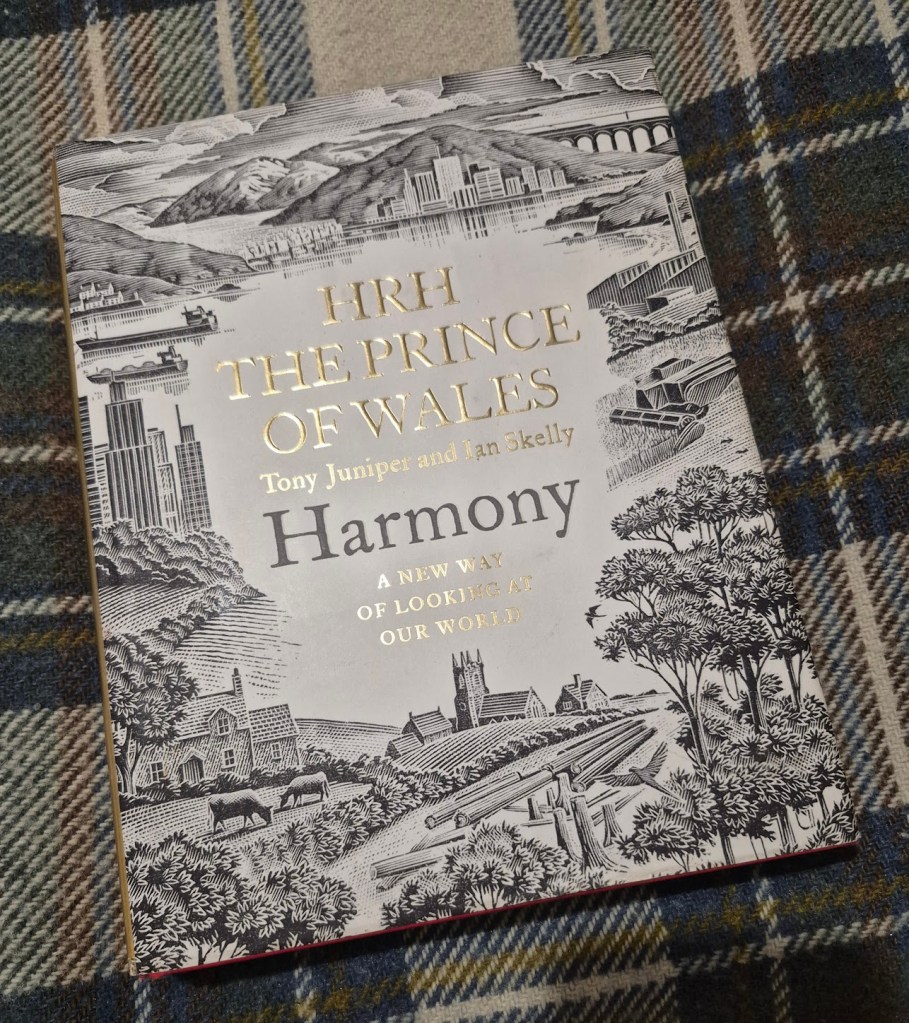
I was very keen to read this book, because I can really get behind King Charles’s interest in the natural world, in where our food comes from, the state of the environment, how we live and how we build our buildings: from what I knew already of his interests and views I thought I would probably agree with much of what this book had to say, and that it would also provide a lot to think about. I am happy to report that this was, in fact, the case.
I know that there are people who might see who wrote this book and instantly be put off, or somehow assume that Charles won’t know what he’s talking about: if this is you, put these thoughts aside for a moment and focus on the message of the book. (I will also point out that here is someone in a position of enormous privilege, with a great deal of soft power, who is doing something good with his platform. Is it not a good thing that those of us living in Commonwealth Realms have a head of state who has spent so much of his life not only being interested in such worthy causes, but also speaking up about them as he has? Also, the King is Head of the Commonwealth, and the ideals explored in this book are similar to the goals of the Commonwealth: he has been championing them all his life, long before he ever took on that role.)
Harmony was written in collaboration with two advisors, whose contributions can mostly be seen in certain sections where their particular subject knowledge is needed, such as the chapter about the effects of climate change, but the rest is very much just one man’s vision for the world. But what a thought-provoking vision! I found myself agreeing with a lot of it, and even where I wasn’t necessarily convinced for certain, it still made me think.
The essential argument is that we have become used to looking at the world in a particular way, a way in which we are disconnected from Nature, and which ignores the fact that we are disconnected. This has also become the mainstream, modern, way of looking at the world, but instead we must work with the grain of Nature, understanding the limits Nature has imposed upon herself, rather than bending her to our will and taking without giving anything in return. Operating in this way = Harmony.
What does this look like in practice? It isn’t just about re-thinking our relationship with the natural world, but the interconnectedness of everything in our world, which means not separating the spiritual and the scientific but valuing them both, and not just setting a possible solution aside because it is at odds with ‘the modern way’. These approaches are something that I, for one, have not seen in other writings about nature. This book is challenging us to see the world differently, whether in terms of how we grow our food, how we build our houses, how we treat illness, and how we approach education: put Nature back in her rightful place, at the centre of how we see our world, rather than relying too heavily on our modern technology to solve problems that we probably caused in the first place. This is not to deny to the role of modern science and technology, but ‘to find as many ways as possible of reintegrating traditional wisdom with the best of what we can do now so as to demonstrate how we might make this age fit for a sustainable future’. The best of the old and the best of the new? I can absolutely get behind this. Similarly, embracing the spiritual does not make one anti-science, and appreciating the potential of modern science does not mean one needs to reject the spiritual. Finding the balance between the two also gives us a sense of duty towards the natural world rather than just a right to act however we want: another point I found myself agreeing with is that ‘our approach cannot all be based on ‘rights’. There have to be ‘responsibilities’ too’. YES: this is something I think applies to society more broadly, and one that many people could do with hearing…
I found the discussions of food production and the built environment, both addressed in Chapter 5 (out of seven), the most thought-provoking, so will focus on those here. Chapter 5 is probably my favourite chapter, in fact, as it considers some of the possible solutions to our problems, thinking about what could be, what should be, and how people might live, in a sort of ‘if it works there, could we make it work in other places too?’ kind of way.
Food production is a useful lens through which we can see how we treat the natural world, especially as we use so much of the land on Earth for food production. Food miles, soil degredation, monocultures, deforestation, and the loss of the variety of crops that are resistant to various diseases are all issues associated with food production. And because food production is part of a system, not elements in isolation, it is a good example of what this book terms ‘whole-istic’ thinking, or the connectedness, that we are missing in today’s view of the world. All very sensible so far: think of what we get from Nature as our ‘ecological capital’ that we can’t just spend profligately, because Nature’s limits must be our limits.
This is where the Duchy of Cornwall comes in. On this estate, spread across the south-west of England, is the Duchy Home Farm, covering c.1000 acres. As Prince of Wales, Charles turned it, against some opposition, to organic farming. ‘Organic farming’ sounds new and alternative, but really it is old and should be mainstream: it’s just how pre-industrial farming was, and it works within Nature’s limits. And surely the food must be healthier because there are no chemicals involved in its production, which improves the health of the people who eat it – another example of connectedness. Shouldn’t all food be grown this way? I hear people moan about the monarchy owning so much land…but look what good has been done with some of that land!
On the subject of the built environment, it is something we need to re-think going forward, creating places rather than just housing estates, and making sure planning objectives actually fit the needs of the people who live in a place. This is what is happening in Poundbury, a town on the Duchy of Cornwall estate. In the 1980s the Dorset County Council needed to build more houses, especially for people on lower incomes, on the Duchy of Cornwall land. Development was going to happen, but what should it look like? This was going to be a town built according to the grammar of Harmony: this meant thinking about things like what would best fulfil the needs of the local area, the way the houses were built and designed and heated, and whether people could walk to most places. This would not be yet another soulless housing estate built according to Modernist ideals that were at odds with the language of Harmony. I just really want to visit Poundbury now, but I also think that this is also a great example of how, if you are going to be very wealthy, you can do something good with that wealth and actually take an active, positive, interest in how people live.
There was one aspect of the book I was less convinced by, and this was the argument that sometime during the Scientific Revolution/Enlightenment/Industrial Revolution (essentially, somewhere between the seventeenth and nineteenth centuries), something shifted in our way of seeing the world, and we stopped acting in Harmony with Nature and starting seeing it as something to exploit for our own benefit, and this new view became so mainstream that it has become the only reliable way to view the world ever since. This felt like quite a broad claim; I don’t think it’s necessarily wrong, but I was reading another book at the same time as I was reading Harmony, Keith Thomas’s Man and the Natural World: Changing Attitudes in England 1500-1800, and it presented a more complex picture, in some cases at odds with the claims made in Harmony; in it, there were very early historical examples of Nature being seen as something there for humans to use and much later examples of humanity trying to respect Nature’s limits. But I do think the overall point here still stands: we have reached a point, probably not helped on by developments like the Industrial Revolution, where we see Nature as something to use, to consume, and to destroy, rather than something with which we share a sacred connection. Has this always been the case historically? No, not necessarily. Does it need to be the case now? No: the modern way does not need to be the only way.
I really respect the ‘but does it really have to keep being this way?’ tone of the book. A lot of the changes proposed here would require very different expectations of what is ‘normal’, and our priorities would have to be different. For example, we eat a lot of produce that is grown to look nice in the shops and yield large harvests: could we get used to eating something that was less perfect and yielded smaller harvests? A society is judged on its economic growth and how much people can afford to consume, but could we instead think of how we live rather than how much we produce and consume? Yes, and we need to, albeit cautiously, implementing change in small, sustainable, steps rather than calling for a complete revolution. This book dares to voice those thoughts and ask those questions, alongside constructively suggesting possible solutions based on the ‘fundamental, timeless realities of our existence on Earth’.
This book is bold, this book is sensible, and so is the vision behind it: it describes a world I would like to live in. King Charles knows he will have critics and doubters, ‘but if they choose to dismiss such a vision, then it is incumbent upon them to come up with something better’.

