Have you ever heard of the artist Emily Carr? If you live outside Canada, there is a good chance you haven’t. She was a painter from Victoria, known for capturing the landscapes and indigenous culture of British Columbia’s coast. Her style was bold and untraditional, influenced by the time she spent training abroad, and later by her striving to capture the essence of an omnipresent God, the feeling of a place rather than the surface details. The art scene in Victoria, though, just didn’t really get it. Emily Carr did not receive much recognition for her art until later in life, and even this was fairly limited and she never really made a living from her painting.
If you are from Victoria, you will certainly have heard of Emily Carr as an artist, but did you also know she was an author? I didn’t know this until fairly recently, but Emily Carr was the author of five books, and her journals were published as well. The books are largely collections of short stories based around a theme, and usually, although not exclusively, based on Emily’s own life.
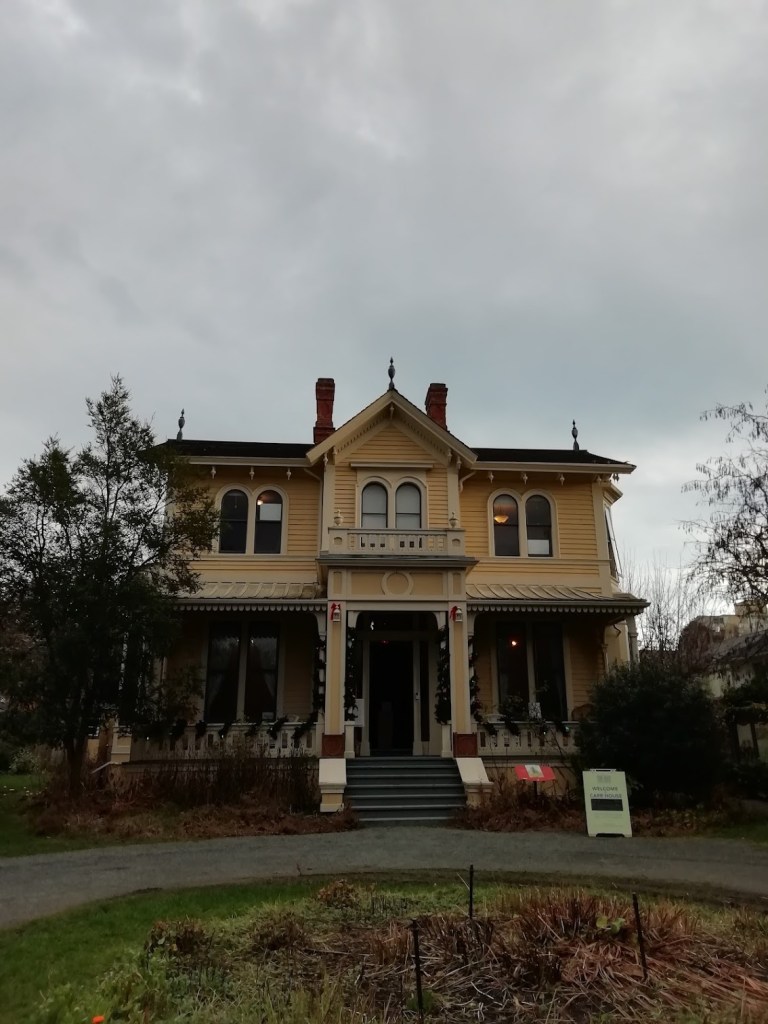
I do enjoy the style and subject matter and feeling of being ‘there’ that Emily’s writings evoke, but I particularly love them for being a window onto Victoria as it was in the late nineteenth and early twentieth centuries. If you have been reading this blog for a while you will know that I am from Victoria, although I don’t currently live there, and that I love to learn about how a city used to be. These books are immersive: I can usually get into any story and imagine it all clearly in my head, but when it’s mostly set right in Victoria, I am there, I am standing in Simcoe Street in front of the House of All Sorts, I am walking down Government Street and turning in at the gate of the beautiful yellow Carr house; I know where Emily means when she speaks of taking a bus out to Millstream like it’s the edge of the world; I know Beacon Hill Park with its peacocks. I just want to know how it all looked back then, how it was and why and all that.
If you have never seen Victoria and are not sure what I am talking about, let me back up a bit and tell you about Victoria. I have talked about it in a couple of previous posts (Island Exploring and I Shall Find It On The Map Part 2), but let’s revisit it here.
Victoria is a city on the west coast of Canada, at the southern tip of Vancouver Island (not to be confused with the city of Vancouver, nearby on the mainland; Vancouver has long been the bigger city but Victoria is the capital of British Columbia). For millenia this land belonged several indigenous groups; what is now central, downtown, Victoria belonged to the Lekwungen people, known today as the Songhees. The land began to be colonised by mainly English settlers in the 1840s. Named for Queen Victoria, and initially a Hudson’s Bay Company outpost, this was a settlement that from the beginning wanted to assert its ‘Englishness’ as a bastion of civilisation on the far edge of North America. Emily Carr’s family were an example of this, living in a very young, very new, Victoria but holding onto their English ways of living.
The centre of Victoria is built at the edge of a harbour, and today the city covers much wider ground, a land of hills and (small) mountains, oak trees and vast evergreen forests, pebbly beaches and little rocky islands. Much of this wilderness has been built over, but there are many areas in and around Victoria that are still ‘wild’ (see the photos below). Victoria is also home to the oldest Chinatown in Canada, and one of the oldest in North America: the Chinese presence in Victoria goes back to the early days of the city’s existence, but the Chinese inhabitants of Victoria were not always treated well, and in Emily Carr’s writing, they mostly feature as domestic servants and manual labourers. She does mention a couple of Chinese people in her journals, and finds some common ground with them when it comes to appreciating art, but the prevailing views of Victoria’s Chinese community at that time were generally much more negative.
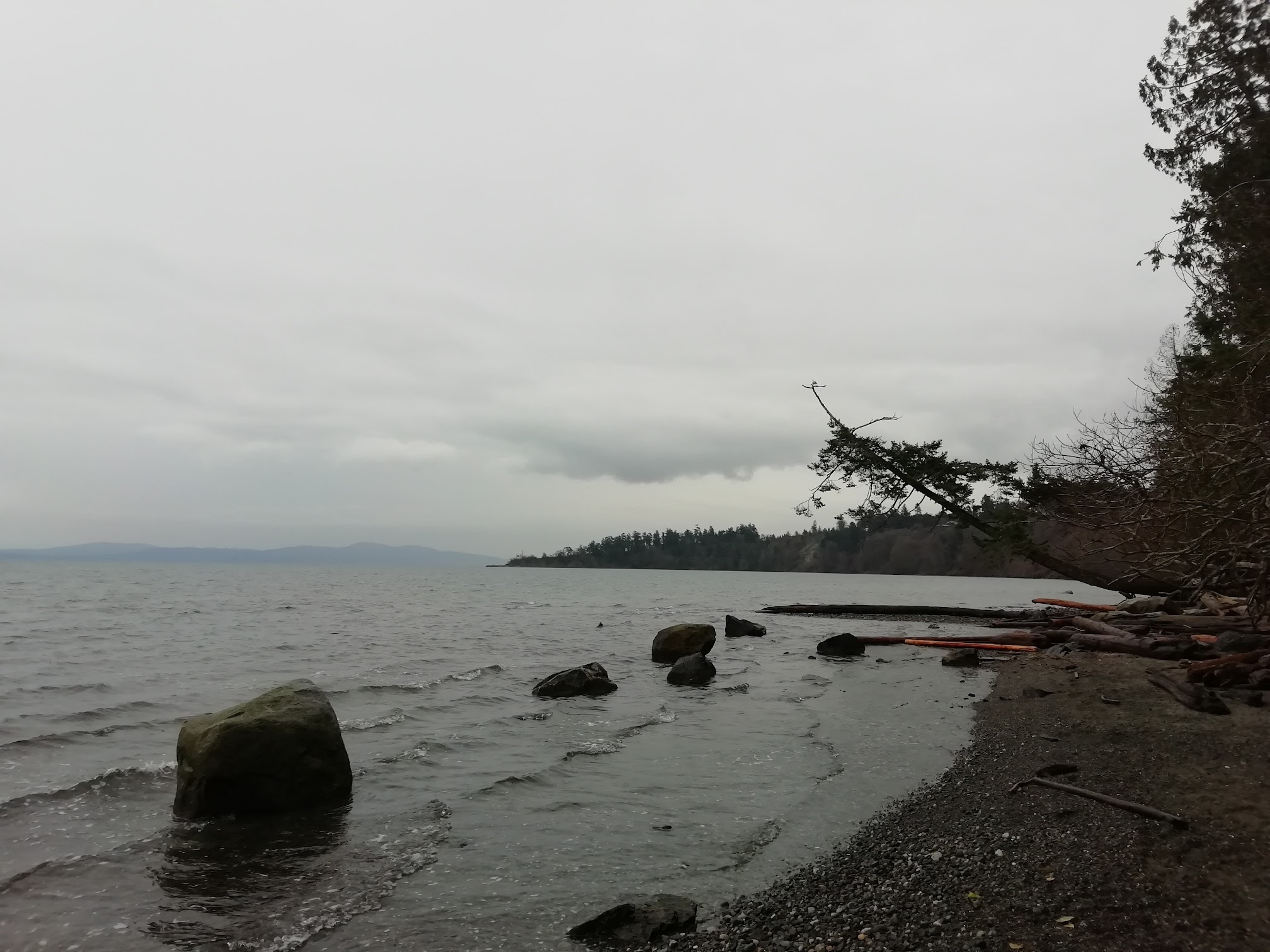
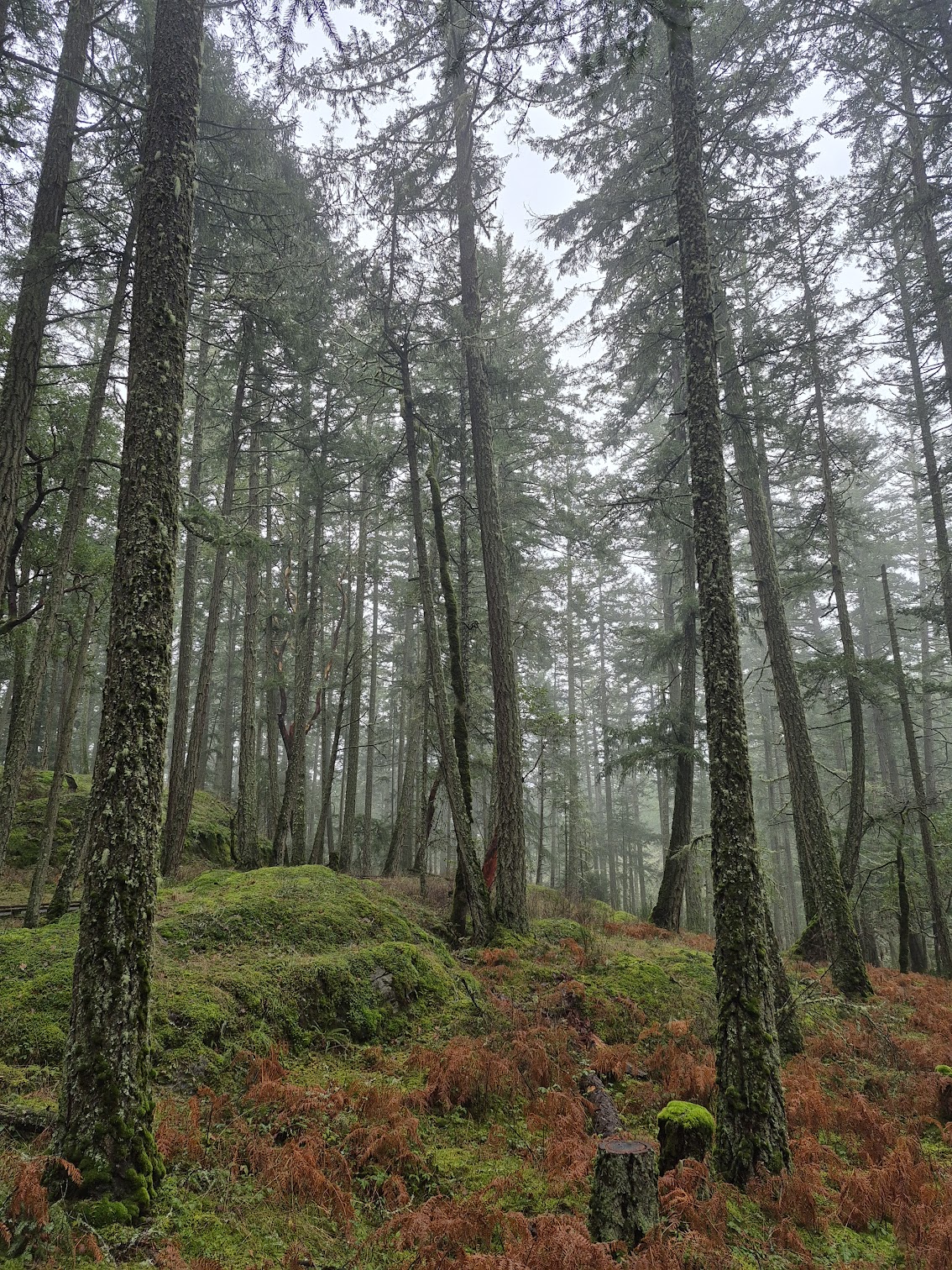
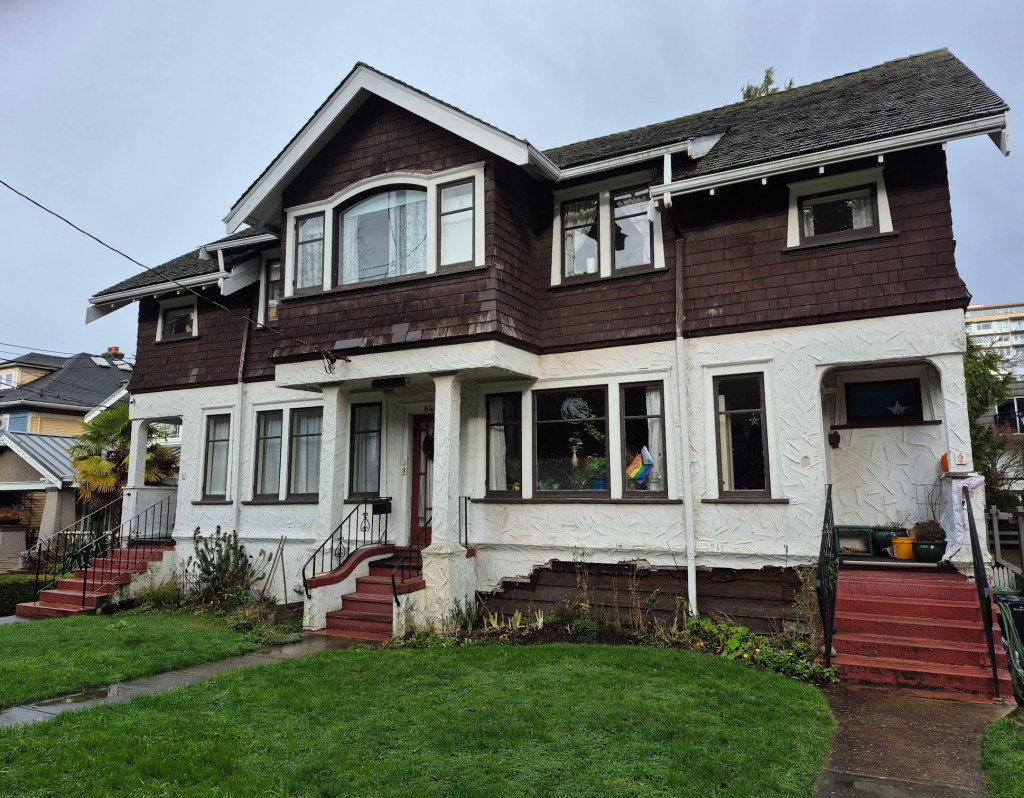
So that is the context in which Emily Carr (1871-1945) was living and painting and writing. Her family had come to Victoria from England, via California, in 1863. They owned an extensive piece of land, which was later divided between Emily and her sisters, who all had a home on this property: to anyone familiar with Victoria, this was most of the land between Government Street (part of which was actually referred to as Carr Street because Emily’s father donated the land to widen the road) and Beacon Hill Park. Compared to her four older sisters Emily was a free spirit, fascinated by the natural world; as an adult she would own a little caravan, ‘The Elephant’, that she would take out into the outskirts of Victoria on painting trips, and had lots of pets, including a monkey named Woo. She trained as an artist in San Francisco, and later London; these were the places that had the art schools and were the centres of the art world in a way that Victoria was not at the time. She hated London, but stayed there, and in England generally, for several years, from 1899 to 1905; she writes in her autobiography that she saw Queen Victoria’s funeral procession. Later (1910-12) she travelled to France, to better understand the modernist art movement, and travelled extensively up and down the coast of British Columbia visiting the indigenous villages, to paint them and the wilderness in which they were located. This subject matter features most commonly in her earlier painting; later her emphasis would shift towards landscape more generally. She spent the 1910s and early 1920s painting, but could not make a living from it; on the land she and her sisters owned she built a house, divided into apartments, and lived as a landlady for fifteen years. This experience is recalled in The House of All Sorts, and the House of All Sorts itself still stands. Emily painted a magnificent pair of eagles on the attic ceiling – what a find for whoever would later occupy the attic floor!
The conservative art world of Victoria was not ready for Emily Carr and her style, but in 1927, years after she had given up trying to make a living as an artist, she was invited to take part in an exhibition of indigenous art at the National Gallery of Canada, in Ottawa (her contribution to this exhibition would have been pictures of indigenous art; I am not sure how much genuine indigenous art was actually featured). This was where she met the Group of Seven. They remain today very famous Canadian artists, known for their landscapes, and were successful at the time Emily met them, forging ahead with their artistic style just as Canada was forging ahead as a young dominion within the British Empire: ‘I know they are building an art worthy of our great country’, as Emily described them in her journal. Their encouragement set Emily back on track as a professional artist. After a heart attack in 1937, however, she had to slow down, and couldn’t go out on expeditions into the wild, with her little caravan and troupe of animals, like she used to, so she turned to writing, something she had in fact been pursuing for several years before. She would continue in this vein until her death in 1945.
What did Emily Carr write? There were five books: Klee Wyck, detailed below; The Book of Small (‘Small’ being her third-person term for herself as a child; this one is also detailed below); Growing Pains, her autobiography covering her artistic training and travels abroad; The Heart of a Peacock, about the animals she owned as well as some other short stories (my favourite parts of this are the chapters about Woo, the monkey she bought from a pet store in Victoria to save her from being bullied by the bigger pet monkeys); The House of All Sorts is about her experience as a landlady and as a breeder and seller of bobtail sheepdogs. Hundreds and Thousands is her journals, which I am reading and loving at the moment. The books are written in a straightforward and direct style, not overly wordy and descriptive; the sentences are short and to the point, sometimes wonderfully blunt. This minimal style, though, says a lot.
Of the five books, my two favourites are Klee Wyck (1941) and The Book of Small (1942). These two are probably the best windows onto the past, blending the familiar with the unfamiliar. The Book of Small is a collection of memories of Emily’s childhood in a Victoria that was, at that point, only a few decades old as a city, still surrounded by the wilderness of the west coast. She speaks of taking a bus out to Mill Stream, like it’s an expedition into the wild, because it was: the Millstream area is part of the Langford suburb now, and the actual Mill Stream still exists, but back then, the stream itself was the destination. Medana’s Grove (also spelled ‘Medina’) is mentioned as a picnic spot near where the Carrs lived, and there is currently a Medana Street in that area; the ‘grove’ is entirely built over. Emily visits a family who lived out by the Gorge, an extension of Victoria’s harbour, and I can picture exactly where she means and wonder whether the house still exists since there are some old houses in that area still. These places are casual mentions, because they were just the familiar places she knew, but they are exciting for me, because they are the familiar places I know, which are usually still there, although often much altered, or if they are not actually still there, there is a street name or something to remind us of their existence.
Klee Wyck chronicles Emily’s visits up and down the coast of British Columbia visiting indigenous villages with an eye to painting them. The title of the book comes from Emily’s nickname, ‘laughing one’, in the language of the indigenous people of Ucluelet. Possibly my favourite part of Klee Wyck is a short chapter – the chapters are generally very short – in which Emily describes being at ‘one of Victoria’s beaches’ (I was imagining somewhere right near Beacon Hill Park or Dallas Road; she is able to see Trial Island from this beach so it could have been anywhere along the southern Victoria/Oak Bay coastline). An indigenous family show up in their canoe, paddle ashore, light a fire and cook some food, put up their tent, and go to sleep. That is, literally, all that happens in the chapter. But I love it: this was a Victoria where the indigenous people still practised some elements of their traditional way of life, a way of life that was being erased, but which had not yet been completely taken away. This family’s arrival on the beach gives us a glimpse of that life. Emily states that ‘the Government allowed [them] to use the beaches when they were travelling’, so this family were making camp en route somewhere. It’s something so simple, so evocative and immediate, and also so sad, because you know that freedom was disappearing.
I think Klee Wyck should be read in schools. Not just on its own; I think it would need some contextualising with other source material from the period, but there is such a push, rightly, to learn more about the indigenous heritage of Canada, and even though Klee Wyck isn’t written from an indigenous perspective, it was written at a time when First Nations culture was being systematically erased, when adopting white culture was being seen as the way to get ahead (even among some of the indigenous people themselves, as Emily narrates). How were the indigenous people living and how did the white population make them change their ways? Klee Wyck explores this through the lens of someone who is still somewhat of her time – the indigenous people are described as Indians, for example, in the language of the period – but who is also sympathetic to, and interested in, the indigenous culture, who has no automatic assumption that it was inferior to her own. Klee Wyck was heavily edited in parts when it was initially published because it critiqued the practice of missionaries setting up schools for First Nations children. Emily travelled with the missionaries, as they were often her only means of safely travelling out into these remote communities, but she did not get along with them. One asked her to persuade an indigenous woman she had befriended to send her sons to what sounds like one of the residential schools, and Emily refused to, entirely unconvinced that there was any advantage to be had in sending one’s children away to such a school, where their indigenous identity would be completely repressed. Despite this censoring, Klee Wyck won the Governor General’s Literary Award in 1941, which is quite a big deal. What a window this book is, onto a culture that today we want to know about and celebrate, written at a time when said culture was being suppressed and eroded. Klee Wyck isn’t a book that is wildly provocative, but it still provokes a reaction. It still makes you think. And you know I love a book that makes people think.
I am currently reading Emily’s journals, Hundreds and Thousands, compiled between 1927 and 1941. Another side of her comes across here, which is not as visible in her other books, that of someone who is, in her own words, ‘always listening to the voice of God in nature’, seeing ‘God in all’ and nature as God revealed to us. At least in her later years, this was the impulse that drove her style of painting, trying to capture God as manifested in his creation. She loved being out in nature, and preferred it to the company of humans, but there was more to it than that. For her, nature was where God was. This makes complete sense to me; there is a perfection to the natural world, a feeling of peace there, that can only have come from the divine. Expressing that, visually, was something Emily strove for. I have to say she certainly achieved it in words: there are some passages in Hundreds and Thousands that resonate so much that I am moved to note them down. I think some of her paintings give me this sense as well: I feel like I am physically there in the middle of that living wilderness, but there is also an intangible, almost dream-like, feeling as well. You feel the natural world it as much as see it, and the same is true of Emily’s paintings.
I hadn’t really given Emily Carr’s art a lot of thought; I just knew who she was and that she was one of my people, a fellow Victorian. I do like her painting, but most of the admiration comes from knowing it was her work and knowing the context in which it was created; if you didn’t tell me it was Emily Carr it might not intrigue me the same way. But I really enjoy her writing. I am glad that I have found something more to admire about one of Victoria’s Well Known People. Emily was representing the West Coast, representing Canada, unashamedly so, and I love that.
Further reading:
You can find Emily Carr’s writing fairly easily in hard copy, in Canada; otherwise, you can find all of her work digitised (just search ‘Emily Carr). Not quite as satisfying as a physical book, but much appreciated when the physical books are not to be had: https://www.fadedpage.com/
For a browse through her work, the National Gallery of Canada has a large selection of Emily’s paintings and sketches: https://www.gallery.ca/collection/search-the-collection?f%5B0%5D=field_reference_artist%253Atitle%3AEmily%20Carr

