I love to imagine how a place once looked. This is particularly the case for cities I know well: if I were to walk through York, for instance, x number of centuries ago, would I be able to find my way around? How different would it be? Thinking about all those layers of history is absolutely thrilling.
Good examples of such change and continuity over time are York’s churches. York has around twenty medieval churches still standing today. Sometimes they have been turned into something else, like St Oswald’s church just outside the city in Fulford, which is now a private home, cemetery in the front garden and all. Some have been partially rebuilt, such as St Martin’s in Coney Street, heavily damaged by bombing in 1942. Some, of course, still operate and have active congregations. But many others disappeared long ago.
I speak only of parish churches here: I’m not counting the monastic houses which were dissolved in the 1530s, because that’s a whole other topic by itself. I recently read a list of vanished parish churches in York, and decided it would be fun to go and find what’s left of them.
What is left of these former churches varies considerably. Sometimes it’s nothing at all. Sometimes it’s only the name of a street nearby. Other times, however, the remains of the church are much more visible.
What follows are a few examples of what you might see (or not see) as you walk around the city, in order to point out and demystify some of the traces of York’s vanished churches.
First, street names. One example in my area of town is in Lawrence Street, where St Lawrence’s church is the only church which stands today. But if you go further down Lawrence Street, heading towards Hull Road, you will notice roads called Nicholas Street and Nicholas Gardens, and a very large green space called St Nicholas Fields. These are all a nod to the church of St Nicholas which stood in the area, as well as St Nicholas’ Hospital – not a hospital in the modern sense, but more a place to look after the poor and the sick, comforting them in body and spirit rather than necessarily curing them.
This is but one example; religious houses also leave their mark on York’s street names, with St Leonard’s place on the site of a hospital of the same name, and St Mary’s and Marygate close to St Mary’s Abbey, for instance. Saints’ names aren’t necessarily indicators of churches or religious houses, but in many cases, they can be.
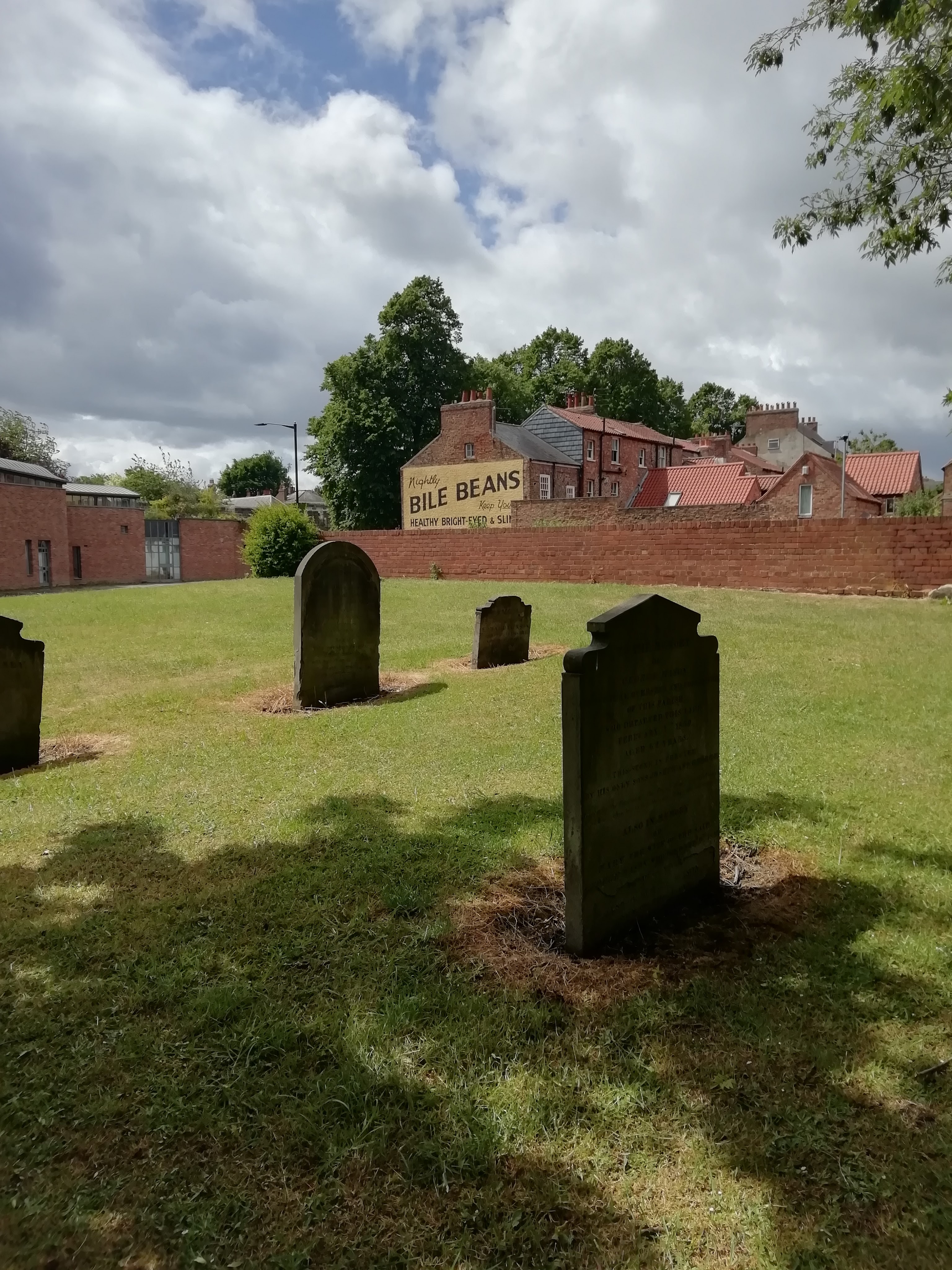
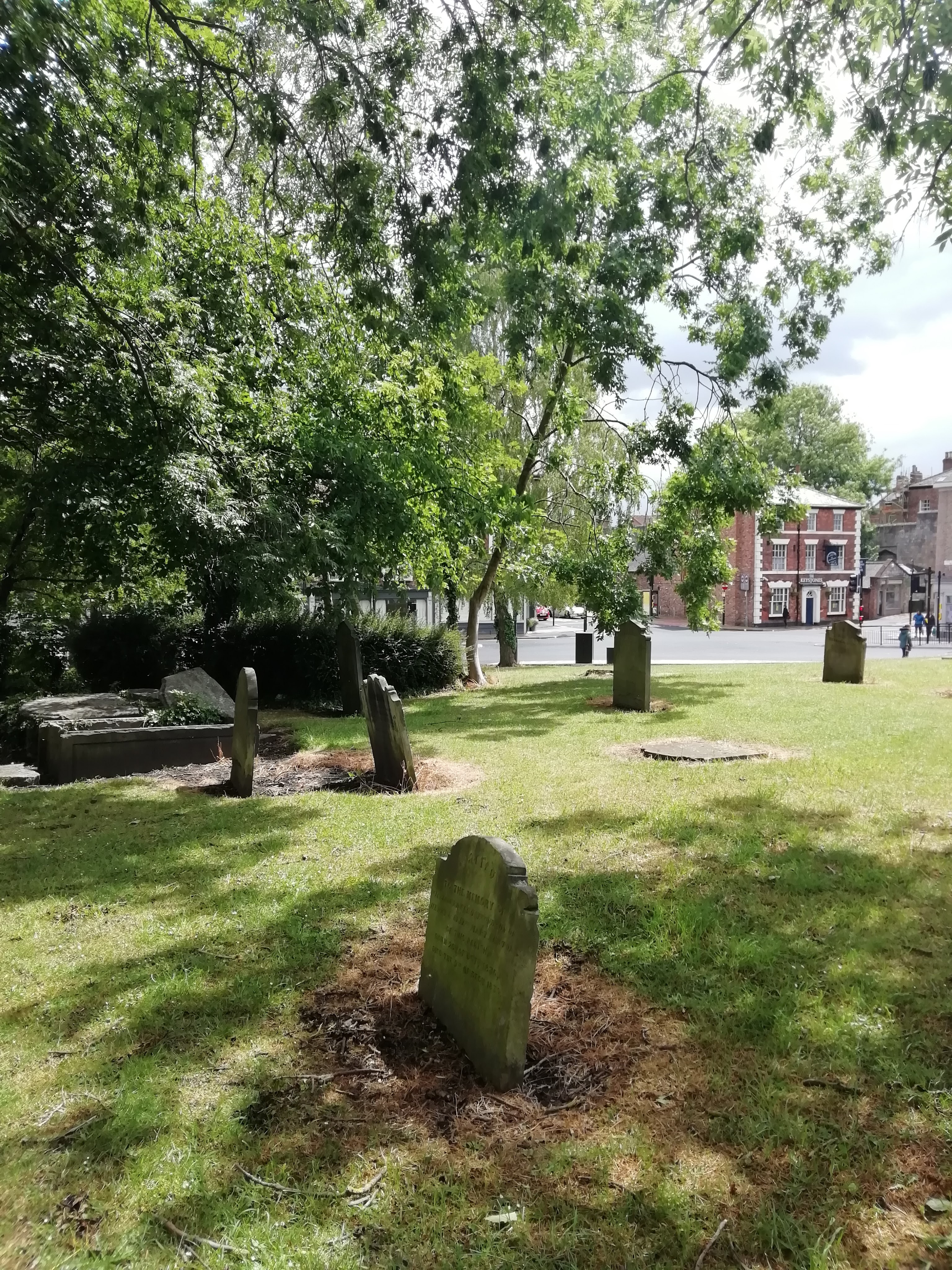
Next, the visible remains. Heading out of York through Monk Bar, one notices a large grassy patch on the corner, near an excellent sign advertising Bile Beans. In the grass are some headstones, because this was once the site of St Maurice’s church. The inscription on at least one of the headstones refers to being located in the chancel of the church, because they once were. The church was rebuilt in the 1870s and demolished in 1969.
Another Victorian re-build, this time demolished in 1937, was Holy Trinity Church (also known as Christ Church), that once stood where King’s Square is now. Some of the paving slabs in King’s Square, just outside the Duke of York pub, are gravestones from this church.
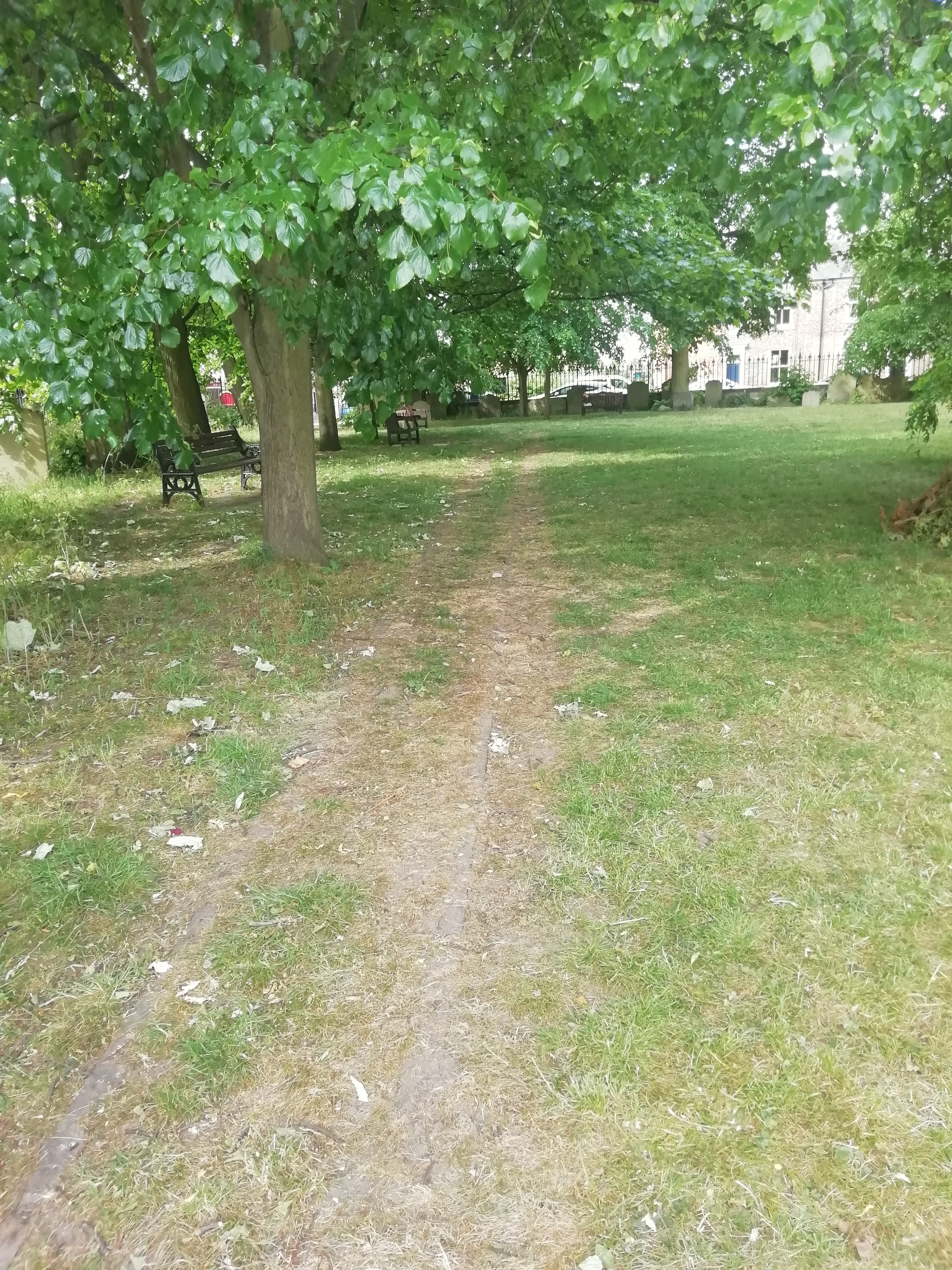
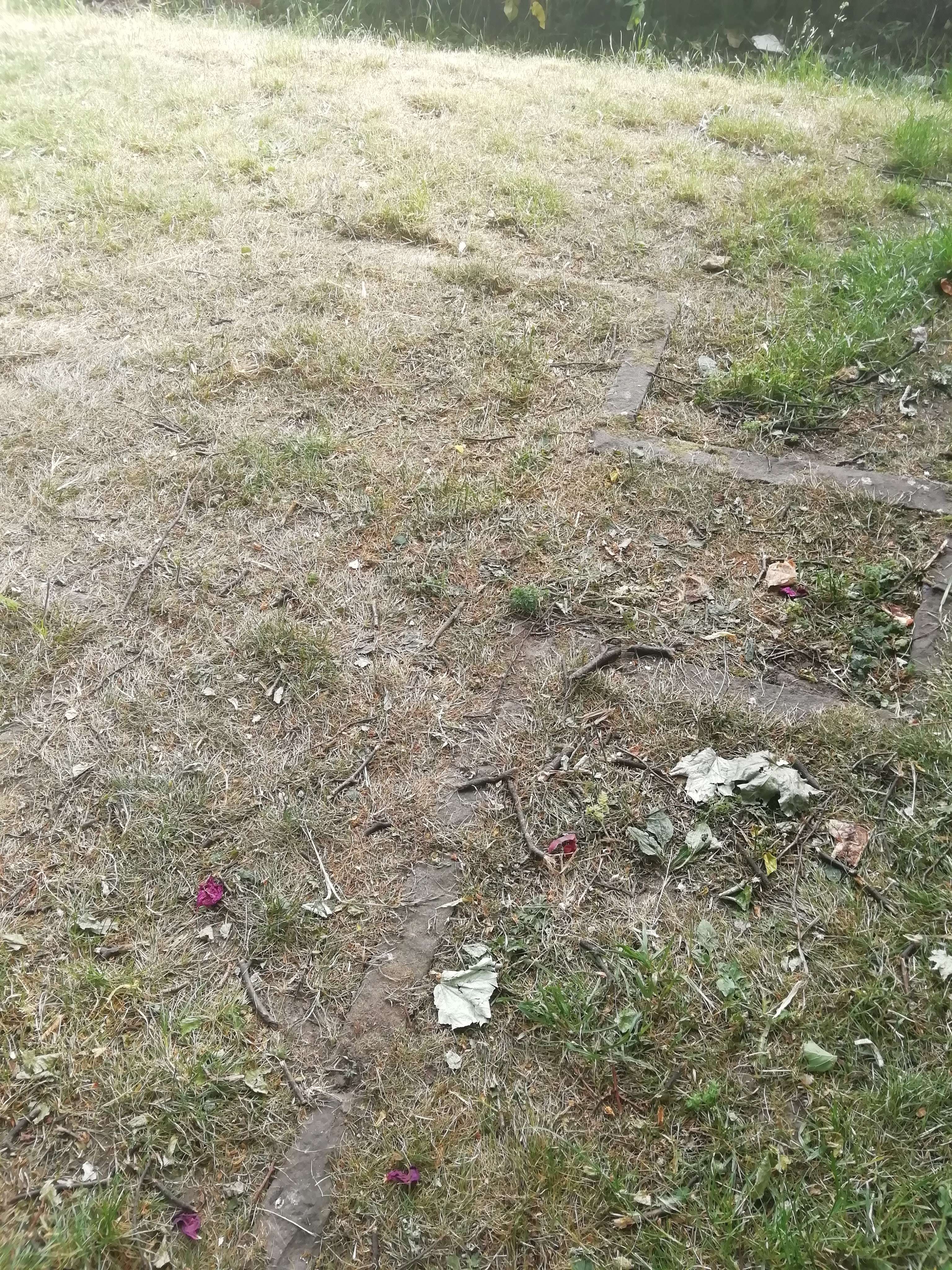
Over the river, just off of Micklegate, there is a church called St Mary Bishophill Junior. It is beautiful; I can also confirm it is an excellent performance space for plays… But if this church is ‘Junior’, is there a St Mary Bishophill Senior? Yes! At least, there was up until 1963. Head to the Bishophill Community Garden nearby, a lovely little cemetery-turned-green-space, and if you look closely at the ground, you can see the outlines of a building: this is the foundation of St Mary Bishophill Senior, another church demolished in the 1960s.
Demolition of ‘decayed’ churches occurred much earlier in York’s history as well. Around 1586, several of York’s churches were united with other parishes and later demolished. Often these churches were not well-enough endowed to survive on their own and so they had to be joined with other parishes, rather than supporting a minister for each church. There had been a plan to do something like this since 1547, but in 1586 the civic authorities, with the Archbishop’s assent, finally made official plans to combine these parishes and demolish the unused churches, meaning that at least a dozen of York’s medieval parish churches disappeared. Consider, too, that this was only fifty years after the dissolution of the monasteries, which had had a profound effect on York’s religious landscape, as it had elsewhere in the country.
One such ‘decayed’ church was St John del Pyke, in Ogleforth/Chapter House Street behind the Minster. I first learned about this church from the foundation document of Archbishop Holgate’s School, from 1546. The foundation mentions this particular church as being near the site of the school. The school seems to have been close to the Minster (judging by Holgate’s stipulation that if the schoolmaster had a wife, she could not live within the cathedral close). But where exactly was this school? OS map to the rescue – the sites of the former church, and school, are clearly labelled as being near the corner of Ogleforth and Chapter House Street. The church itself was demolished in 1587, and in the nineteenth century the school moved out to roughly where York St John University is now, and then further out to the Badger Hill area in the twentieth. If you turn off of Goodramgate and head down Ogleforth and then into Chapter House Street, there is, sadly, nothing to indicate that either the church or the school were ever there. I’ve looked. I suspect both school and church are buried beneath the modern houses that now inhabit the street. All that is left now is a little road north of the city called ‘Del Pyke’, and Holgate’s school, operating in a modern building on the opposite side of the city. But those are both stories for another time…
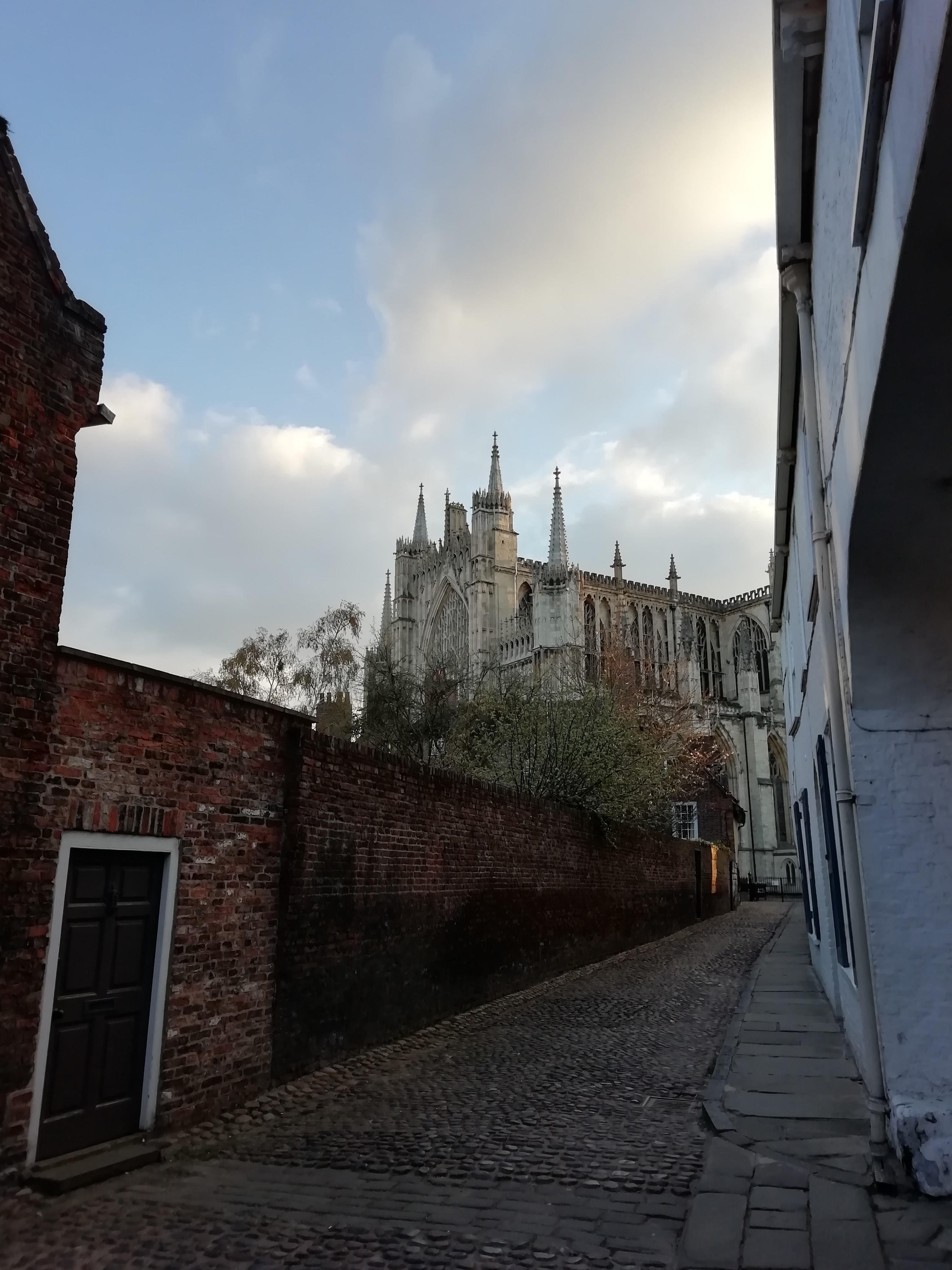
So next time you are out and about in York, and wonder why there are random gravestones on the ground or why a street has a particular name, think of all the churches that used to stand in the city, and how different things must have looked back then. And of course, this doesn’t just apply to York – all the layers of history, some plainly to be seen, others entirely vanished, are one of the things I love most about old cities in general.
Further Reading
The foundation document for Archbishop Holgate’s school lives at the Borthwick Institute for Archives, University of York (Bishopthorpe Papers Bp. Sch. 53, Archbishop Holgate’s Grammar School foundation charter, 1546). This was the first archival source I read for my thesis…
https://www.british-history.ac.uk/vch/yorks/city-of-york/pp365-404 for the full list of churches demolished in the 1580s.
Map of York 1852 https://yorkmaps.net/1852/#17/53.9622/-1.0821
One thing I do appreciate about the York Press is the old photos they feature on their website. Three of the churches mentioned here are included in their archive:
For St Maurice’s church: https://www.yorkpress.co.uk/pics/archive/view/gallery_248177.Evening_Press_archive_images_Vol_II_/#gallery45
For Holy Trinity, King’s Square: https://www.yorkpress.co.uk/news/14329337.37-old-photos-of-colliergate-kings-square-in-york/#gallery5
For St Mary Bishophill Senior: https://www.yorkpress.co.uk/pics/lookback/#gallery11

