One of the main misconceptions about the Commonwealth is that it is just the British Empire under a different name. Although it is true that most of the member nations were once part of the Empire, this is not the case for all of them. I think it is worth looking at how and when the countries of the Commonwealth actually became part of the Commonwealth, and how far it has evolved away from the its imperial roots.
Starting in the mid nineteenth century, some British colonies started to become dominions, i.e. they gained a large measure of independence from British rule, such as dealing with their country’s own internal affairs. In 1926 there was an Imperial Conference, in London, attended by Britain and the leaders of Australia, Canada, India, the Irish Free State, Newfoundland, New Zealand, and South Africa. This was the point where Britain and the Dominions agreed that they were essentially equals within the empire: they shared allegiance to the monarch based in Britain but they were not ‘ruled by’ Britain. This was an early iteration of the Commonwealth, and was further confirmed by the Statute of Westminster in 1931, whereby the Dominions could make and change their own laws without having to go through the UK. Canada, Australia, New Zealand, and South Africa date their entry to the Commonwealth from this point.
When India became independent in 1947, it wanted to become a republic; none of the member nations were republics at that time. India would have been a significant loss to the Commonwealth (it constituted about half the Commonwealth population), so the Commonwealth Prime Ministers met in 1949, and a result of that meeting was that republics could join the Commonwealth: this is the beginning, in 1949, of the modern Commonwealth of Nations, and the point at which they stopped calling it the British Commonwealth. At that stage, the members were the UK, Canada, Australia, New Zealand, South Africa, India, Pakistan, and Sri Lanka. Note the changes from 1926 here: Newfoundland had become a province of Canada in 1949, Ireland left the Commonwealth when it became a republic in 1949, and India, Pakistan, and Sri Lanka had become independent and subsequently joined.
Over the next several decades, other countries joined. This process has unfolded alongside the process of decolonisation: an overwhelming number of the current fifty-six member states joined following independence from Britain, with a particular concentration in Africa, and during the 1960s. Other countries have continued to join, right on up until 2022, with only Zimbabwe leaving in recent years. And yet, if you see the Commonwealth mentioned in the media, there is a tendency to lead with ‘is it still relevant’ and to take quite a cynical angle, instead of stopping to consider what the Commonwealth actually is and actually does. Do the people questioning its relevance even know what it does and how aspirational it has been and continues to be? My guess is no.
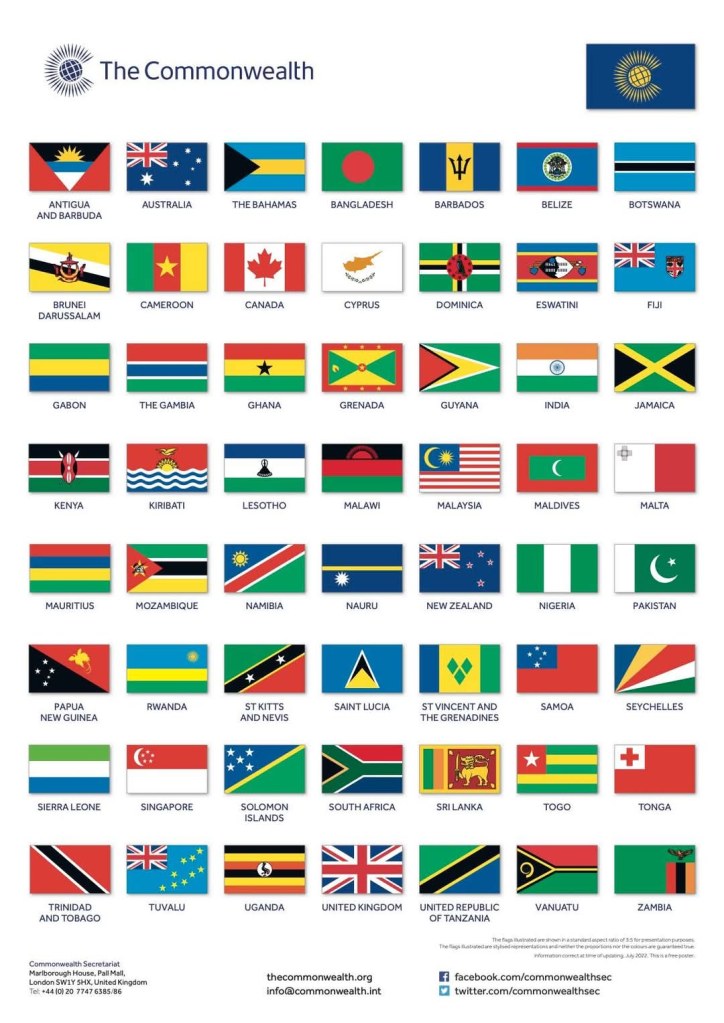
It is worth mentioning here that all of the fifty-six Commonwealth countries are equal in status, and all have joined the organisation voluntarily. I repeat, it is a voluntary association, which no country has been forced to join. They make decisions based on the consensus of all of the member states, each of which have an equal say. For this post I have arranged the countries by geographical region, leaving the Realms to have their own category. The Realms are the fifteen member states who have King Charles III as their Head of State, and I have made them a separate category here because I want to make clear that not all of the Commonwealth countries have King Charles as their Head of State. He is Head of the Commonwealth, but only Head of State of fifteen of the fifty-six countries. Also King Charles was chosen unanimously by the Commonwealth Heads of Government to symbolically lead the organisation; Commonwealth Headship is not hereditary.
We’ll see the phrase ‘following independence from Britain’ a lot, but not all the time (I thought about abbreviating it to something shorter, but didn’t). There is a big question here of WHY did each country join the Commonwealth, but I’m not getting into that now; this post would be very long if I did that. I do touch on the ‘why’ briefly when discussing some of the countries that were not former British colonies, or where their imperial connection is less obvious. There are also questions of how long these countries stayed as Commonwealth Realms, or Dominions, after independence, and for those that chose to become republics instead, what prompted this (and was it a good idea to give up the stability of constitutional monarchy)? How much popular support was there for going in the republic direction? Or how much local support was there for joining the Commonwealth in the first place? Again, for length, we are not getting into all of these questions here. This post started out as a rebuttal of the claim that the Commonwealth is simply another British Empire, but I realised as I was writing it that there was so much more to learn and clarify and boil down, so you’re coming with me on this journey.
AFRICA
Botswana: 1966 following independence from Britain. Republic upon independence.
Cameroon: 1960 following independence from Britain. Republic upon independence.
Eswatini: 1968 following independence from Britain. They have their own monarchy.
Gabon: 2022, partially suspended in 2023 for overthrowing their elected government but restored to full membership 2025. Gabon was a French colony (see below).
Gambia: 1965 following independence from Britain, left 2013 (see below), and rejoined 2018. Was a Dominion until 1970.
Ghana: 1957 following independence from Britain. Was a Dominion until 1960.
Kenya: 1963 following independence from Britain. Was definitely a republic by 1964.
Lesotho: 1966 following independence from Britain. They have their own monarchy.
Malawi: 1964 following independence from Britain. Was definitely a republic by 1966.
Mauritius: 1968 following independence from Britain. Was a Dominion until 1992.
Mozambique: 1995 following its first democratic elections. Mozambique was a Portuguese colony, and in 1995 was the first Commonwealth member state not to have any connection to the British Empire.
Namibia: 1990 following independence from South Africa, who had left the Commonwealth by that stage, but an independent Namibia wanted to be a member.
Nigeria: 1960 following independence from Britain, suspended 1995, restored 1999. Was a Dominion until 1963.
Rwanda: 2009 It had been a German colony, put under Belgian administration after the First World War. (We will see this again with a few other member states, where a country was a German colony and was administered as a ‘trust territory’ by a different country after WWI.)By 2009 prospective countries could be considered for membership on a case-by-case basis, which was how Rwanda was able to join.
Seychelles: 1976 following independence from Britain. Republic upon independence.
Sierra Leone: 1961 following independence from Britain. Was a Dominion until 1971.
South Africa: 1931 following independence from Britain. Left the Commonwealth and became a republic in 1961.
Tanzania: 1961 following independence from Britain (with its borders slightly different to today’s). Was a Dominion until 1962.
Togo: 2022 Was a German colony, administered by France after WWI.
Uganda: 1962 following independence from Britain. Was a Dominion until 1963 but not proclaimed a republic until 1966.
Zambia: 1964 following independence from Britain. Republic upon independence.
So, in Africa we see many countries joining in the 1950s and 60s: sixteen out of twenty-one African Commonwealth countries joined following independence from Britain. Of these sixteen, two had, and still have, their own monarchy, and ten were Dominions initially but later became republics (i.e. the monarch was still their Head of State until the country decided to change that.) But let me also draw your attention to some more recent dates, in this century. Here’s where we see places that were never part of the British Empire wanting to join the Commonwealth. The newest Commonwealth members see membership as a way of forging new partnerships outside of the Francophone world, in the case of Gabon and Togo, or have neighbours which are member states, in the case of Mozambique and Rwanda. Rwanda was a bit of both: its neighbours were member states, Rwanda was starting to use English alongside French as an official language, and was recovering from its genocide approximately a decade earlier. For Rwanda, Commonwealth membership was one way to move the country forward. The fact that countries are joining even into the 2020s, and the fact that these newest members don’t have a prior connection to the British Empire like the other countries had, clearly shows that the Commonwealth is not some moribund holdover of British imperialism.
We also see some examples here of countries being suspended from the Commonwealth: Gabon overthrew their elected government, and Nigeria’s military regime executed an environmental activist. Holding free and transparent elections, abandoning military rule, and electing a civilian government, let both countries be restored to full membership. We see a patten here: extreme behaviour or corrupt behaviour can get a country suspended. Committing to fair and transparent elections and a civilian, democratic, government, can get them back on track to membership again. This is usually done with the help of the Commonwealth Secretariat, an intergovernmental organisation, managed by the Commonwealth Secretary-General, which works to support the member states and their governments in achieving the Commonwealth’s aims.
A country can also leave the Commonwealth. Zimbabwe left and never came back, but coming back is the more common route: Gambia objected to being part of an organisation they saw as colonial (but also wasn’t, or didn’t want to be, on board with the Commonwealth’s commitment to defending human rights). They applied to rejoin a few years later, though, after electing a new president who could see the value of the Commonwealth. South Africa left shortly after becoming a republic: its apartheid government was not compatible with the values of the Commonwealth, but once the apartheid era ended, South Africa could, and did, rejoin.
ASIA
Bangladesh: 1972 following independence from Pakistan (there was an ‘East Pakistan’ which was roughly where Bangladesh is now). Republic upon independence.
Brunei: 1984 following independence from Britain. Has its own sultan.
India: 1947 following independence from Britain, but remember that India set the precedent for republics being part of the Commonwealth, as long as they acknowledged the Head of the Commonwealth (who happens to be a monarch).
Malaysia: 1957 following independence from Britain, when they also established their own elective monarchy.
Maldives: 1982, withdrew 2016, rejoined 2020. Had their own monarchy from independence from Britain in 1965 until 1968.
Pakistan: 1947 on partition from India, was a Dominion until 1956. Left 1972, rejoined 1989, was suspended 1999-2004 and 2007-8.
Singapore: 1965 on leaving Federation of Malaysia and becoming independent as a republic.
Sri Lanka: 1948 following independence from Britain. Was a Dominion until 1972.
Out of the eight Asian Commonwealth countries, four joined following independence from Britain. Two have their own monarchies, one had its own monarchy at the time of independence, three were republics from the time they become independent, and two were Dominions initially. Note the Maldives and Pakistan here, illustrating more examples of how a country can leave or be suspended but then rejoin. The Maldives was threatened with suspension from the Commonwealth unless they made better progress on human rights in the country, so they left of their own accord, but then they sorted themselves out to the satisfaction of the Commonwealth Secretariat and wanted to be members again, so they were re-admitted. Pakistan left in the same year that Bangladesh became independent. It was in protest against Britain recognising an independent Bangladesh. They didn’t rejoin until 1989; it took seventeen years because they couldn’t rejoin until they had a democratically elected government. The Pakistani Prime Minister, Benazir Bhutto, pushed for Pakistan to rejoin because she saw the value of Commonwealth membership.
CARIBBEAN/AMERICAS
Barbados: 1966 following independence from Britain. Was a Dominion until 2021.
Dominica: 1978 following independence from Britain. Republic upon independence.
Guyana: 1966 following independence from Britain. Was a Dominion until 1970.
Trinidad and Tobago: 1962 following independence from Britain. Was a Dominion until 1976.
All four non-Realm Caribbean member states joined after becoming independent. Three out of these four started out as Realms and then switched to being republics, most recently Barbados (I talk about this a bit more in a previous post, ‘Clarifying the Commonwealth: 2025 Edit’). We will meet eight more Caribbean nations when we get to the Realms section. None have been suspended and none have left.
EUROPE
Cyprus: 1961 a year after independence from Britain. Never seems to have been a Dominion (i.e. it seems to have gone from colony to republic)
Malta: 1964 following independence from Britain. Was a Dominion until 1971.
Cyprus had been under administrative control of Britain from 1878, granted to Britain in exchange for British support of the Ottoman Empire; the UK had a military base there and actually still does have two on the island (which are considered British Overseas territories), and it was colony from 1925 until 1960.
Malta had been under French control until 1814, and then it was part of the British Empire, with a UK naval base until the 1970s. Queen Elizabeth II, before becoming Queen and after marrying Prince Philip, lived in Malta for a short time because of her husband’s naval career.
SOUTH PACIFIC
Fiji: 1970 following independence from Britain. Suspended three times (1987-97, 2000-1, and 2006-14. See below). Was a Dominion until the coup in 1987.
Kiribati: 1979 following independence from Britain. Republic upon independence.
Nauru (Naoero seems to be the new spelling): 1968 upon attaining full independence from being a UN trust territory. Never seems to have been a Dominion although it was run by one (Australia). The actual Commonwealth website describes it as being an associate member from 1968 and then a full member from 1999, but associate membership never seems to have been a thing because all member states are equal, so I’m not sure what’s going on there.
Samoa: 1970 ‘following administration by New Zealand’: another post-WWI trust territory. Never seems to have been a Dominion although it was run by one (New Zealand).
Tonga: 1970. It wasn’t technically a colony, and it kept its own monarchy, but was under UK protection, and these ties led to joining the Commonwealth after withdrawing from the British protectorate in 1970.
Vanuatu: 1980 ‘following ending of administration Anglo-French condominium’ (a territory over which more than one country has control. This was Vanuatu 1906-80 because the UK and France both had interests in the islands). Republic upon independence.
Only two of these six were formerly British colonies. Of the six non-Realms in the South Pacific, two were trust territories run by Australia and New Zealand, respectively; one had, and still has, its own monarchy, two were republics right from independence, and one started as a Realm after independence. Fiji was suspended because of coups against their government, and was allowed back in once they passed a new constitution (the first time), and held proper elections (the second and third times). Some Fijians still recognised Elizabeth II as Queen of Fiji even though after the first coup she no longer legally was.
REALMS
Antigua and Barbuda: 1981 following independence from Britain
Australia: 1931 under the statute of Westminster i.e. right from the beginning.
Bahamas: 1973 following independence from Britain
Belize: 1981 following independence from Britain
Canada: 1931 under the statute of Westminster i.e. right from the beginning.
Grenada: 1974 following independence from Britain
Jamaica: 1962 following independence from Britain
New Zealand: 1931 under the statute of Westminster i.e. right from the beginning.
Papua New Guinea: 1975 following independence from being an Australian-administered UN trust territory since 1946.
St Kitts and Nevis: 1983 following independence from Britain
St Lucia: 1979 following independence from Britain
St Vincent and the Grenadines: 1979 following independence from Britain
Solomon Islands: 1978 following independence from Britain
Tuvalu: 1978 following independence from Britain
United Kingdom: they were the founder, so right from the beginning, back when it was still called the ‘British Commonwealth of Nations’
Of the fifteen realms, ten joined after becoming independent from Britain, three were already dominions when they joined, one joined upon gaining independence from Australian administration, and one founded the whole thing (do you ‘join’ if you’re the founder?) Here we see some of the original Commonwealth members from back when it was actually still called the British Commonwealth (which it is not called anymore and has not been since 1949 so stop calling it that). All of the Realms are either in the Caribbean, South Pacific, or North America; there are no Realms in Africa or Asia.
In Africa and Asia we have seen examples of countries which would be considered Realms today if they had not become republics; they were dominions upon gaining independence, because although they were no longer colonies, they still had the reigning monarch as their Head of State. A Dominion and a Realm are similar but ‘Realm’ makes the distinction between a republic and a (UK-based) constitutional monarchy when talking about Commonwealth countries and which ones have Charles III as their Head of State and which don’t, and ‘Dominion’ can refer to anywhere where the British monarch is Head of State, even if they are independent countries. All Dominions would be part of the Commonwealth but not every Commonwealth country is a Realm.
There wasn’t a straightforward empire-to-Commonwealth shift: we’ve seen some examples of countries joining who were never part of the British Empire, in the section about Africa. Some countries which were part of the British Empire did not join the Commonwealth. Burma (now Myanmar), for example, and the colony of Aden (now part of Yemen) never joined at all. Some countries have expressed interest – how serious, I am not sure – in joining. I remember reading about Japan being one such country, but I can’t find any evidence for this now. Ideally a country is meant to have had a constitutional association with a current Commonwealth member state, but applications are considered on a case by case basis, so technically any country can apply to join, provided they meet the eligibility criteria, and provided all of fifty-six heads of government agree to accept their application.
The point of this is really to break down the misconception that the Commonwealth is some outmoded means of holding onto the British Empire. If one looks closely, one can see that that claim is nonsense. The Commonwealth certainly isn’t perfect – some of its member states do have a ways to go in terms of human rights in their countries, for instance – but a group of countries voluntarily coming together and committing to making a positive different in the world is a fine thing, and the fact that its roots are in the Empire does not mean that it is an imperial institution today, and doesn’t mean that we need to be cynical about it.
Further Reading
Have a look at the actual Commonwealth website for a start: it’s interesting to see how they describe themselves, but it is also a great starting point for the who/what/where/why questions, as well as recent news about the Commonwealth, that, alas, you may not find in the mainstream news outlets: https://thecommonwealth.org/ The Commonwealth Charter, as well as various Commonwealth declarations which arise from the CHOGM meetings, are all here as well.
The criteria for joining the Commonwealth: https://thecommonwealth.org/about/joining

