Today is a miscellanea of food history, Anglo-Icelandic interactions, and a French law. What do they have in common? I learned about all of these things from books I decided to read for fun from the library. So, hurrah for libraries. Also, if you understand what the title of the post is a reference to, you deserve a sticker.*
Apple Ambassadors in BC – from The Apple: A Delicious History, by Sally Coulthard
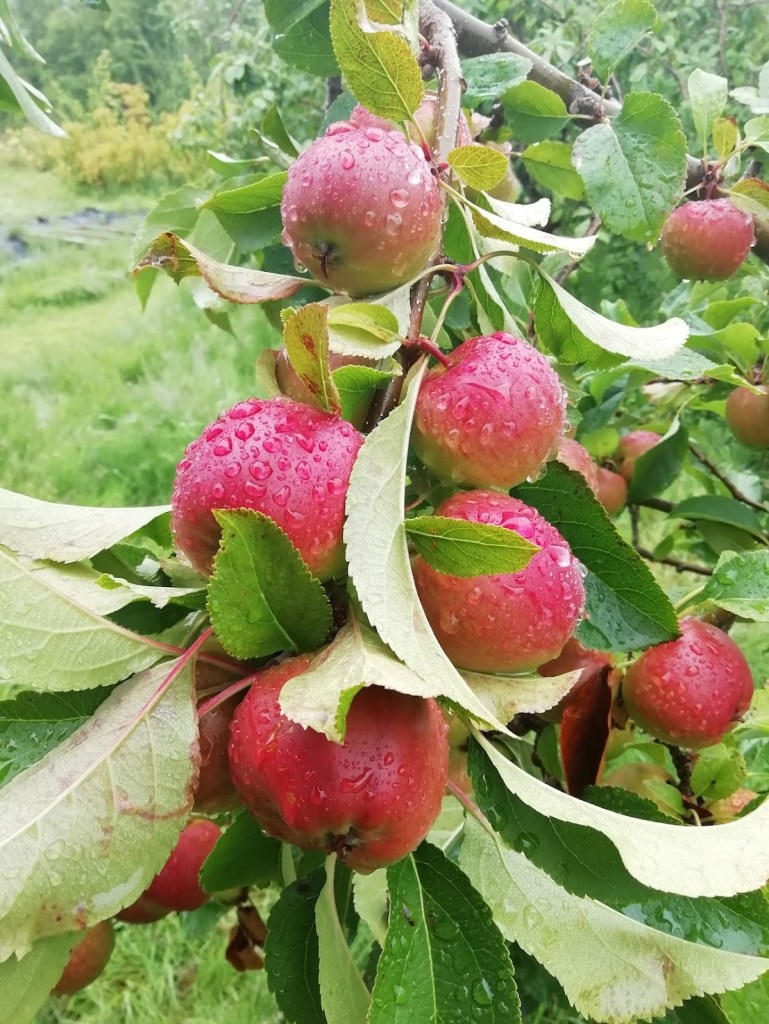
When the Second World War began, Canada was a major grower of apples, and had been exporting much of its apple harvest to the UK. With the outbreak of the war, Canada lost that export market, but was still a major producer of apples. It was time to encourage a local market for those apples. British Columbia in particular grew, and still grows, a lot of fruit, and so the British Columbia Fruit Growers’ Association chose four women to be ‘fruit envoys’, or ‘apple ambassadors’. They visited fourteen cities across the prairies over the course of a month, giving apple demonstrations in shops and schools (what this was, besides apple packing, I am not sure: likely ways to cook and eat apples). They even got the mayors of the cities they visited to sign a proclamation whereby the mayor promised that their city would eat more BC apples. Australia did a similar thing with their produce: it was one’s patriotic duty to eat locally grown food. It wasn’t only apples, apparently; the maritime provinces in Canada produced lobsters, which they were no longer exporting during the war, so lobster was a similarly patriotic food.
Why is this interesting? A) It’s a bit of Canadian history I wasn’t expecting to see in a book about apples, B) It is an interesting take on encouraging people to eat locally-produced food: we need to be encouraging people to do this, but are ‘apple ambassadors’ the way to do it? Maybe? Why not? I sometimes think about the rather alarming statistic that no more than about 5% of food advertising is of fruit and vegetables**, and how wonderful it would be if there were more fabulous pictures of fruit and vegetables out there to make eating them look appealing. I actually think Apple Ambassadors are a good thing…not so much in the patriotic sense (Canada already has plenty of that at the moment – Canadians WILL buy the Canadian apples right now), but in the eat-more-fruit sense. We could certainly use more of that message, especially ‘eat more locally produced fruit’.
William Morris and the Iceland famine – from How We Might Live: At Home with Jane and William Morris, by Suzanne Fagence Cooper
You may know William Morris as a designer of wallpaper and furnishings; he was an artist, author, agitator for social change, and really quite a visionary of, as he put it, ‘how we might live’. I thought this all sounded interesting, so I read a biography of William and his equally interesting wife Jane, and learned, initially, that William went to Iceland, twice, loving the simplicity and wildness of the country. This is interesting in itself, but he was visiting in the 1870s, and Iceland, at that time, was struggling. Alongside volcanic eruptions, the winters were unusually cold and the summers unusually cool, so the harvests were ruined and livestock died, the thicker-than-usual sea ice made it harder for ships to bring in supplies, and many Icelanders faced the prospect of starvation; to escape the famine, many emigrated, something we will address later.
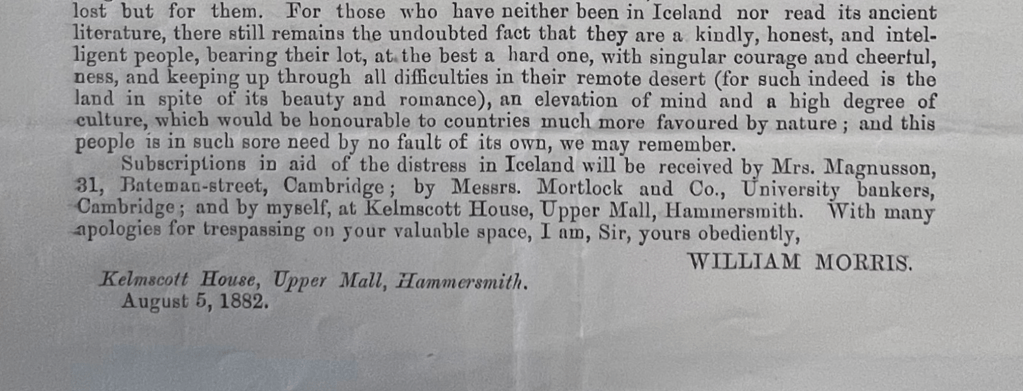
William Morris was aware of this situation: he wrote to The Daily News in August 1882 to explain the situation, appealing first to those who had visited Iceland, then those who would know and appreciate the country’s history, and then to people’s compassion for a ‘kindly, honest, and intelligent people’. There was sympathy, in England, for the Icelanders. William was very keen to have a relief committee set up, and to be on this committee himself, and to donate to it (he gave £10 straight away, worth over £600 today). He and his Icelandic friend Eirikur Magnusson were involved in the relief efforts; the Mansion House Relief Committee raised over £2000 within a few weeks. Copenhagen’s Minister for Iceland was aware of this committee – remember that Iceland was under Danish rule at this time, hence the minister being based in Copenhagen and the need to deal with Danish officials – which suggests it must have been well-publicised.
Some of this publicity, however, made the famine out to be less extreme than it was: William urged his friend Eirikur to get statements from officials in Iceland saying that it really was that bad, in case anyone tried to downplay the severity; in the end the negative publicity and a ‘is-it-really-that-serious’ scepticism meant that the Mansion House Relief Committee closed itself down and sent the money it had managed to raise to a relief committee in Copenhagen, whence it would hopefully have reached Iceland. I would like to know more about where these reports were coming from, saying that the situation wasn’t that bad, because it was certainly serious enough for thousands of Icelanders, strong and resilient people, to leave Iceland in search of a better life elsewhere.
Why is this interesting? A) It’s something about William Morris that I never knew about, B) It’s an insight into how much the affairs of somewhere like Iceland were understood in somewhere like the UK, at a time before mass communication and before the world became so ‘connected’ and C) My own great-great-grandparents lived in Iceland right around this time, and were part of that Icelandic diaspora, that wave of emigration out of a country that was struggling with bad harvests exacerbated by harsh weather. Theirs was the struggle that William Morris and his committee were trying to alleviate, so to have this unexpected insight into what was happening in my ancestors’ homeland was really fascinating.
France and protected sensory heritage – from England: A Natural History, by John Lewis-Stemple

In France, a law was passed in 2021 which was designed to protect the ‘sensory heritage’ of the countryside. It was proposed because people would come and visit the countryside, or even keep second homes there, wanting peace and quiet, and complain because they heard things like roosters crowing and cow bells ringing. This law is essentially saying that you can’t complain about the countryside sounding like the countryside. It protects things like the sounds of chickens, ducks, and geese, frogs, cows and cow bells, church bells, grasshoppers and cicadas, and even early morning tractor noise, because these are the sounds of the rural landscape. All of the news stories about this law mention Maurice the rooster and how someone didn’t like him crowing, but roosters crow in the countryside, and that is just the reality of rural life.
When I first saw a mention of this law in the book I was reading, from the context I thought it was going to be something about preserving the disappearing sounds and smells of the natural world, protecting them from going extinct. That is sort of what this French law is doing, but largely in the context of farmland, and sound and smell. It is interesting that the law itself comes under the category of heritage preservation, from the French Ministry of Culture, rather than being something more environmentally-focussed. Whether from a heritage or environmental perspective, though, protecting the sensory landscape still sounds like a valuable idea. What sensory aspects of the natural world would be on that list? All manner of bird song, sheep baa-ing, cows mooing, the smells of certain plants, the sound of the wind in the trees, the smells of the sea or a tidal river, the holy silence of a forest… and it would all be gloriously different depending on where in world you were.
Why is this interesting? A) Think of the sounds, smells, and sights of the countryside. What do your senses associate with the natural world where you live? That is precious and irreplaceable and I wonder whether other countries, as well as France, do this too? Not that I have been able to find: University College London has done some ‘olfactory heritage’ projects surrounding historical smells, which is certainly interesting, but this is different to that. B) It is a form of heritage and nature preservation, just from a specific sensory angle, and C) The world is very noisy. Excessive traffic, alarms, people using their phones on speaker in public without earphones…noises like these – especially the last one – are an absolute menace and are noise pollution. City sounds can spill over into being noise pollution, but country sounds, somehow, can’t. They are, I think, what we are meant to listen to, and are therefore worth preserving.
So, to revisit the title of this post, head on down to the library. The Public Library is an institution that should be protected at all costs. You get the thrill of a new book to look forward to without having to spend any money, and you never know what you might learn.
Further Reading
For a bit more about the fruit envoys, see https://bcfoodhistory.ca/apples-and-patriotism/ In fact, all of the articles on that website looks interesting: I’m particularly intrigued by ‘Chinese market gardeners in BC’…
https://morrisarchive.lib.uiowa.edu/items/show/3002 for the full letter to the newspaper mentioned in the post.
‘William Morris, Eirikur Magnusson, and the Icelandic Famine Relief Efforts of 1882’, Richard L Harris, Viking Society for Northern Research, vol 20 (1978-1981), 31-41.
For more about what was happening in Iceland in the 1870s until about 1914, the Icelandic Emigration Centre, in Iceland, breaks it all down clearly, with a timeline and all: https://www.hofsos.is/general-6
The sensory heritage law itself, ‘à définir et protéger le patrimonies sensorial des campagnes françaises’ is harder to find, but there is a lot of news coverage about it: https://www.france24.com/en/europe/20210121-france-upholds-rural-sensory-heritage-over-city-slicker-grousing is probably the best one.
*Arthur. It’s from the TV show Arthur. ‘Having Fun Isn’t Hard When You’ve Got A Library Card’ is a song from a musical episode the show did, and it is pretty much a masterpiece.
** An interesting article from the UK Food Foundation gives an even smaller number https://foodfoundation.org.uk/sites/default/files/2024-04/Briefing%20-%20Advertising%20v2.pdf

