
This post is the second half of a two-part look at two topics which are very important to me, both closely related and both inadequately understood: the Commonwealth, and the Monarchy. I am far from an expert in this subject; I am still learning about the monarchy, for two reasons: the country I am from (Canada) and the country I live in (the UK) are both constitutional monarchies, so it behooves me to know about their very similar political systems, and I have always supported the monarchy, it has always just felt ‘right’ to me, but I want to know more about why I should, so that I can support it in an informed way, rather than just blindly. I also want to be better at defending the monarchy, and the Commonwealth as well, when people speak up against them.
The point of this post, therefore, is not to give you all of the answers, but to – hopefully – make you think. As with the Commonwealth post, I speak for the institution of monarchy only in the British and Canadian contexts, and as with the Commonwealth post, we’ll structure this around common objections I hear:
‘It’s an unelected government’ : Not quite so. If you live in the UK, or Canada, for instance, you have an elected government. You get to vote for your representatives. The Queen holds a different role as head of state. The head of state (i.e. the monarch) is a hereditary role and therefore not elected, but the head of government (the Prime Minister) is elected. The head of state is also not meant to be political. It’s not like the monarchy is some sort of dictatorship, and it is certainly not tyrannical, which was a description I once heard: consider what tyranny actually means – government by one person who acts for their own good and without taking any advice – and how this does not describe the monarchy anywhere remotely…
‘It’s expensive/taxpayer funded’ : It is, in part, taxpayer-funded, and yes, it might look expensive, but apparently not as expensive as other forms of government (have a look at the sources linked in the further readings, which breaks down the cost of the monarchy in Canada and in the UK. The Canadian one gives a comparison with some other institutions within Canada, like the House of Commons, and with other monarchies or other governments, many of which are more expensive). In Canada the cost in $1.68 per person, and in the UK £1.23, at the time of writing. In the UK this money is largely for the upkeep of the historical buildings associated with the monarchy and for supporting the Queen’s official duties as head of state. The Canadian taxpayer only pays for the Queen’s role in the Canadian context: we don’t pay for anything to do with her residences in the UK, we pay for things like the maintenance of the Government Houses for the vice-regal representatives in each province (historic buildings which would be maintained anyway) and for when the Queen is physically in Canada as our head of state (because there are always costs associated with hosting a visiting head of state). It’s not like that money is all just the Queen’s pocket money. A related criticism is of how rich the royal family are: yes, they are very wealthy people, and I would not dispute the fact that there are areas of society which should be better funded. But I’m not really sure that ‘the royal family are rich therefore I do not like them’ is a very constructive criticism. And it is not like the Queen and the senior members of her family sit around and do nothing: think about the role of head of state, of politically neutral figurehead on a global, Commonwealth, scale, and all of the engagements the Queen has successfully carried out all her life, and indeed still does at the age of nearly 95. Other jobs are obviously far more difficult, of course, but that doesn’t mean that the role of Sovereign is just a sinecure, so the argument that the monarchy is somehow sponging off of society does not quite add up.
In Canada, you might hear the complaint that the monarchy is some foreign institution: no, my compatriots, it is not. Her Majesty’s role as ‘Queen of Canada’ is separate from her role as Queen of the United Kingdom, or of Australia, or of New Zealand, or of [insert Commonwealth Realm here]. She may be physically based in the UK, but she is our Queen every bit as much as she is the Queen of the other Commonwealth Realms.
‘I don’t like Charles and don’t think he should be King’ : This is because of Diana, isn’t it? More on this later. The monarchy, as I once heard it masterfully described, is not a popularity contest. While there might be some admirable individuals, it is about the institution rather than its individual members. People also have a tiresome and ignorant tendency to seize on one negative thing, one person who slipped up, and use that to criticise the entire institution, completely ignoring any good things it has done.
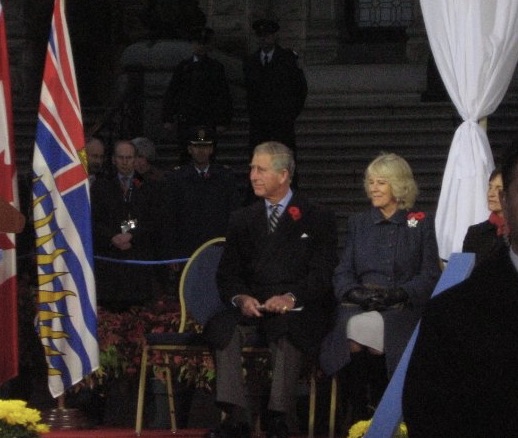
‘Monarchists are either just royal watchers, or rich old conservatives’ : This is a huge generalisation. Sure, I was thrilled when the Queen drove past when my family and I were in Edinburgh one time, and you bet I went down to the Legislature when Prince Charles and the Duchess of Cornwall visited Victoria; it was all very exciting. But I support the institution itself, and the stability, unity, and continuity it provides, rather than just get excited about seeing individual members of the royal family (so I’m not keen on terms like ‘royal fan’, ‘royal watcher’, etc; they are very superficial). And yes, many political conservatives support the monarchy. But you can support the institution of monarchy and not be politically conservative in other areas. Living in a tolerant, fair, society is not incompatible with living in a constitutional monarchy: think of the kinds of things the Commonwealth countries are trying to do, in support of the environment, gender equality, education, human rights, that sort of thing. I support all of those things and the monarchy, and I am not alone in that, so I think sensible, reasonable, support of the monarchy, and indeed the Commonwealth as well, is something that is entirely possible: we can have this middle way.
What alternative would you propose, and would that actually be any better? The monarch is politically neutral, so we have a head of state who stands above all of the political change, someone who is a focus for continuity and unity in a way an elected head of government would not be. The Queen is head of the Church of England as well, but that shouldn’t put you off either: just because she is associated with a particular branch of a particular religion, does not mean she cannot represent the freedom to follow other faiths, or none. The institution of monarchy has historically adapted with the times, while still maintaining a sense of continuity, so the argument that it is somehow an outdated institution does not really hold up.
Finally, the TV series The Crown has a lot to answer for, particularly at a time when many people are so misinformed about the monarchy. Of course the monarchy has had its darker moments, of course the situation with Diana was awful, but The Crown runs a serious risk of leaving people with the wrong impression of events, unless they look up the facts, which many don’t do. The most recent season, 4, is particularly problematic in this regard: that season deals with the very people and events that the public seize on when they want to criticise the monarchy, and though it may be ‘just TV’, it can, and no doubt is, informing people’s views about the monarchy, and contributing to some people’s very superficial understanding of it (although if it prompts you to go and learn more about the monarchy, that’s good). If you do watch The Crown, though, listen to the Queen in the episode about the Commonwealth in season 4, as she defends its purpose and continued existence to a critical Margaret Thatcher (or read my previous post, which says essentially the same thing).
Further Reading
The 2019-2020 financial reports on the cost of the crown in the UK are available online: https://www.royal.uk/financial-reports-2019-20
The Monarchist League of Canada works to increase awareness of the monarchy in Canada, including how much it costs, which is all helpfully broken down here: https://monarchist.ca/images/CMN/CostoftheCrown_2019.pdf
Finally, some answers to some common questions about the monarchy in the Canadian context: https://monarchist.ca/index.php/our-monarchy/myths-about-the-monarchy


2 thoughts on “De-mystifying the Monarchy”